
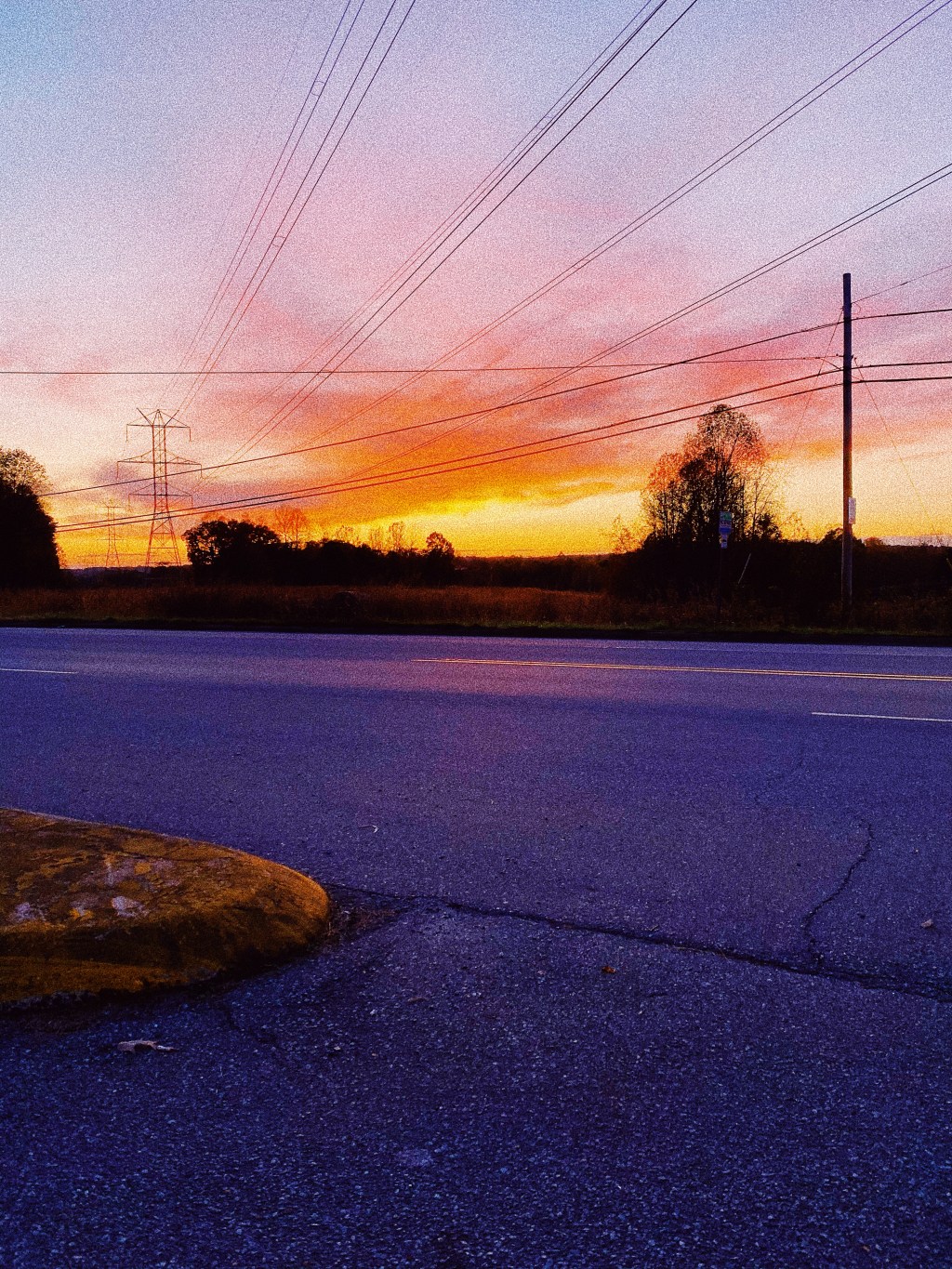
“Life is tragic simply because the earth turns and the sun inexorably rises and sets, and one day, for each of us, the sun will go down for the last, last time. Perhaps the whole root of our trouble, the human trouble, is that we will sacrifice all the beauty of our lives, will imprison ourselves in totems, taboos, crosses, blood sacrifices, steeples, mosques, races, armies, flags, nations, in order to deny the fact of death, the only fact we have. It seems to me one ought to rejoice in the fact of death—out go decide, indeed, to earn one’s death by confronting with passion the conundrum of life. One is responsible for life: It is the small beacon in that terrifying darkness from which we come and to which we shall return”.
James Baldwin, “The Fire Next Time” (1963)
I am writing this because I am stuck in the trunk of a stolen luxury sedan, confined to a jump seat with everybody else’s luggage storing the leg room I don’t have. My feet are tucked and craned to accommodate the passengers sitting in front of me, with their seats leaning back in my lap; all their weary, all their weight, all their mess, in my lap. Where I sit, the air conditioning does not reach. My seat hugs the window, and the sunlight—filtered by the glass—sinks its cleats into my forearms and the tops of my thighs, piercing through my clothes. My forehead is coated in sweat that drips at random, and the smell of expired deli meat dances on my shoulders and under my arms. I am stuck in the rear, invisible until the car stops.
When the car stops, my work begins and my discomfort intensifies. A stopped car means there’s an empty tank to fill, a mangled engine to fix, and a flat tire to change. There’s a car to be pushed out of the mud using only my exhaustion, my dehydration, my anger, and my desire to get to where I am supposed to be. A stopped car means there are car snacks I am forced to buy for everyone using my last, my meager, my all. A stopped car means there’s a vehicle full of people depending on me, needing me, draining me, exploiting me, . . . killing me. In every moment of this on-going saga, I am stuck.
I am often told, however, my position is only temporary. All the car’s occupants repeatedly assure me they will take me to my destination, and for that, I endure. All the while, everyone else has leg room because I don’t. Their seats recline because mine can’t; they feel the air conditioning because I wait for passing trees offering a moment of shade. They are going home because I am without one—or so they tell me. Stuck. With every exit “accidentally missed”, I am stuck. In my seat. In my service. In my discomfort. In my life. In my mind. In their car. Stuck as occupant, never the driver. Stuck on a journey that is not mine.
And what of my condition when the driver and everyone else in the car finally arrive at their destination, and I, marooned millions of miles away from mine, am left alone? Do you think they’ll give me the car keys so I can drive myself home? Will they help me build a plane? Will they buy me a boat? Will they pay my train fare?
Even now, considering all I do for them, they don’t see me, nor do they desire to. Will that change when I no longer serve a purpose to them? What seat are they willing to take for me? What discomfort will they endure to get me home? What will they surrender to make me whole? What home will they help me build? Do I even know how to get home? Even in abandonment, I am stuck.
But why must I resign to stuck? Why must I only know the confines of a trunk or a promise? Why must I resolve myself to the isolation that is the seat in the rear? How much more must I shrink to fit here? How much smaller should my life get? Because even in the midst of my little, my uncomfortable, my isolation—I’ve dreamt of bigger, better, stronger, quicker, sleeker, more sustainable cars. Cars driven by me, and only me—heading to destinations I deem suitable. So, I write this as a reminder: I am stuck in the trunk of a stolen luxury sedan, and I must dream my way out of here; I must dream my way home. I must tell myself stories about myself. I must paint pictures of myself. I must sing songs about myself. I must envision a destination worth the journey. I must create a life worthy of death, and fight for it. I want to be responsible for my life; I must be. So now, I write for me.
WE are the Fire and Light Collective, and we are making art because we are stuck. Maybe not in the literal seat of a trunk, but in unnecessary hardship, in a cycle of living to work and working to live, in shame we don’t want, in limitations we don’t want, in struggles we don’t want, in expectations we don’t want. As artists surviving capitalism, we are forced to shed our humanity to fit into arbitrary confines designed to anchor someone else’s fantasy; we are damned to a version of hell so someone else’s heaven has more space, calacatta marble floors, and beige decor. The longer we live in hell, within the limits of stunted imaginations, we forget our reflections. We forget where we come from, and why it matters. Why we matter. Why alternatives matter.
We must continue telling our stories, singing our songs, painting our pictures, dancing to express, and writing to clarify. Creating to liberate ourselves from what isn’t ours, and begin making our way to the destinations we have dreamed of. In this issue, we begin our journey by examining ourselves and exploring our history, our culture, our spirituality, and our dreams for a better world.
The Fire and Light Collective of Greensboro, North Carolina—spearheaded by artists Ajani Elyse, J. Da Storm, james solomon, Kay Marion, and Sloan Hampton Taylor (es. hampton)— envisions a thriving artistic community empowered to create unhindered by convention and the constraints of capitalism and its many tools. Art is transformative; it can communicate truth, illuminate the unknown, and change the world. Thus, as Audre Lorde states, “art is not a luxury; it’s a necessity”.
Read more here: Fire & Light Collective
 SLOAN HAMPTON
Leave a comment